top of page
There's plenty to see and do at the estuary.
The estuary walkway provides beautiful views, and there are signs along the way providing information about some of the birds you might see.
There is a lot of interesting wildlife at the estuary. As well as birds, the estuary is also home to some interesting plants and is an important habitat for native fish.
The Manawatū Estuary Trust enjoys giving people the opportunity to learn more about this amazing environ

Matuku hūrepo/Australasian Bittern Botauris poiciloptilus
Native. Threatened - nationally critical.
This rare species is found in Aotearoa New Zealand, Australia and New Caledonia where it inhabits areas near water that are heavily vegetated.
Once said to inhabit suitable areas around the "Loop" with reports of up to seven being sighted at various times. Unfortunately, a brief survey in 2024/5 failed to record any, as did a similar one around the Estuary. It is hoped to undertake another, more thorough one in the 2025/6 breeding season. There is an abundance of small tuna (elvers) around the edges so food should not be a problem in raising any young. Water quality might be a problem though.
During the breeding season males "boom", to attract females to their territories and it is this call that gives them away, as does their characteristic silhouette when flying. If you are lucky enough to see one, please report it using the contact form on support MET page
NZbirdsonline-Australasian Bittern

Conservation management of the critically endangered matuku-hūrepo/Australasian bittern: a review of threats and preliminary management techniques.
By: Emma M. Williams. 2024. Department of Conservation Science for Conservation 341. 64 p. (PDF, 10,309)
Australasian Bittern sightings around Foxton and Foxton Beach area
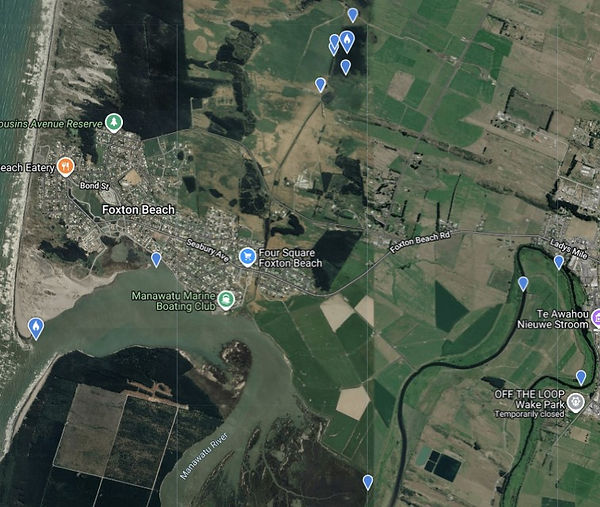
The sightings on the above map are taken from eBird and indicate that there are several locations where bitterns can be seen around the area. There are also a number of unrecorded sightings from at least two other locations, including from the viewing platform at the end of Dawick Street. Around the beach area it is likely to be only isolated observations as habitat is not that suitable, while the cluster at the top of the map around Lake Omanu indicates a favoured location. The blue teardrop at the bottom is on the edge of Fernbird Flats while the three around the Loop also occur in suitable habitat with both these likely to be hotspots which need increased monitoring, details of which can be found in the document below.
Protocols for the Inventory and Monitoring of Populations of the Australasian Bittern (Botaurus poiciloptilus) in New Zealand.
By Colin F.J. O'Donell and Emma M. Williams. 2015. Department of Conservation Technical Series 38
Valuable information can also be found via Bittern Conservation Trust website.
Panui The Great Matuka Muster 2026
LoveBittern Newsletter June 2025
bottom of page